
My Milagros Cross
March 29th, 2010
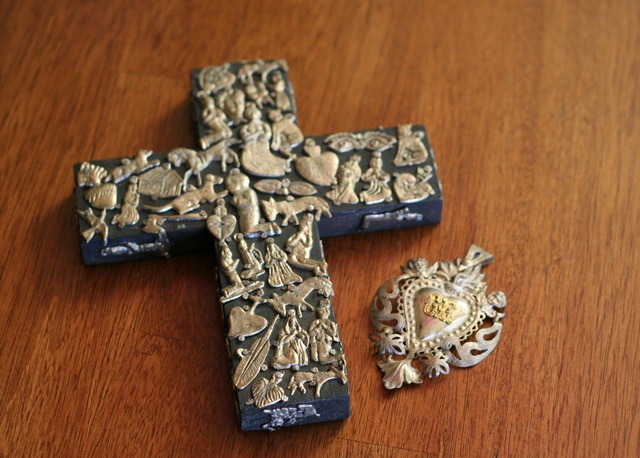
This was my gift along with my story to Curt of grace received.
Milagros are religious folk charms that are traditionally used for healing purposes and as votive offerings in Mexico, the southern United States, other areas of Latin America, as well as parts of the Iberian peninsula. They are frequently attached onto altars, shrines, and sacred objects found in places of worship, and they are often purchased in churches, cathedrals or from street vendors.
Milagros come in a variety of shapes and dimensions and are fabricated from many different materials, depending on local customs. For example, they might be nearly flat or fully three dimensional; and they can be constructed from gold, silver, tin, lead, wood, bone, or wax. In Spanish, the word milagro literally means miracle or surprise.
History
The use of milagros is a folk custom in parts of North, Central, and South America, and it is claimed that the custom is traceable to ancient Iberians who inhabited the coastal regions of Spain. The use of milagros accompanied the Spanish as they arrived in Central and South America. Although the custom is not as prevalent as it once was, the use of milagros or ex-votos continues to be a part of folk culture throughout rural areas of Spain—particularly Andalusia, Catalonia and Majorca.
As part of a religious ritual or an act of devotion, milagros can be offered to a symbol of a saint as a reminder of a petitioner’s particular need, or in gratitude for a prayer answered. They are used to assist in focusing attention towards a specific ailment, based on the type of charm used. Milagro symbolism is not universal; a milagro of a body part, such as a leg, might be used as part of a prayer or vow for the improvement of a leg; or it might refer to a concept such as travel. Similarly, a heart might represent ideas as diverse as a heart condition, a romance, or any number of other interpretations. Milagros are also carried for protection and good luck.
"Dear Curt,
My Aunt Joe gave me this cross that she got in Venice when I first got sick in 2000. Under your name on the back of the cross, it says Aunt Joe 12-21-00. I have used it as a prayer guide to focus my thoughts on healing when the pain was so great. In Spain, they put these charms on their doors. Aunt Joe says there are so many charms that the doors are fully covered in these metals (beautiful symbolism to put on our door, the opening to our home and dwelling place). Anyway, something else I find fascinating with the milagros charm tradition, is that when the prayer is answered, it is custom to put a charm on top of the prayer request charm that has the letters “G.R.” standing for “Grace Received” (gracia recibida in Spanish).
Grace is received in many forms. Some people receive their pardon here on earth, as in earthly healing. I wish we could see more of this. Others find grace received in the journey. My grace, or free gift, is that I am now a better person, more compassionate, less proud, and stronger from dealing with my pain. Either here on earth, or when you get to heaven, you will receive your grace. Our ultimate grace is that God loves us and cares for us through his Son’s suffering sacrifice, an offering of His relationship with us, just as we suffer here on earth.
May God restore your body and bring you complete earthly healing, our “surprise,” yet if we may be so deprived, I pray you will discover grace everyday to help you through.
May this cross be a symbol to you and your family for prayer, protection, good luck, miracles, but most of all, grace, even when we don’t know the receiving date.
All my love and thoughts and prayers,
Melissa"
“Let us then approach the throne of grace with confidence, so that we may receive mercy and find grace to help us in our time of need.” Hebrews 4:16
“But with God, all things are possible.” Matthew 19:26